
25th Anniversary of the Building of the Pedestrian Bridge in Golden, BC
The Timber Framers Guild of North America: Masters of an Ancient Craft
The Kicking Horse Pedestrian Bridge could not have existed without the extraordinary generosity of the Timber Framers Guild of North America. Founded in 1984 to preserve the ancient art of timber framing, the Guild is a community of skilled artisans dedicated to keeping alive joinery traditions that built Europe’s great halls and bridges long before the first wire nail was ever driven.
Joel McCarty, the Guild’s executive director, understood the urgency of the mission. “These building techniques were all but wiped out by the invention of the wire nail and the power sawmill,” he explained. “The knowledge is no longer passed on from father to son like it had been for thousands of years. Now you have to study old bridges and books. So our work is a way to bring the knowledge back, and to pass it on.”
The Guild is selective about the projects it takes on. A build must serve a genuine community purpose, and it must be impossible to complete without the Guild’s donated labour. The Kicking Horse Bridge met both tests. McCarty could barely contain his enthusiasm: “A project of this size happens once every five or ten years, maybe. We couldn’t be happier to be here.”
In the first two weeks of September 2001, more than 100 Guild members — journeymen and master timber framers from across the United States, Europe, and Canada — arrived in Golden to put those skills to work. They came not for wages, but for craft, community, and a trade they refused to let die. True to the Guild’s open spirit, anyone from Golden who wandered down to the work site was welcomed and immediately put to work alongside the masters.
When the first great truss rose on the evening of September 4th, everyone gathered at the riverbank knew they were witnessing something rare.
Golden Rolls Up Its Sleeves: Local Volunteers and the Community That Cared for Them
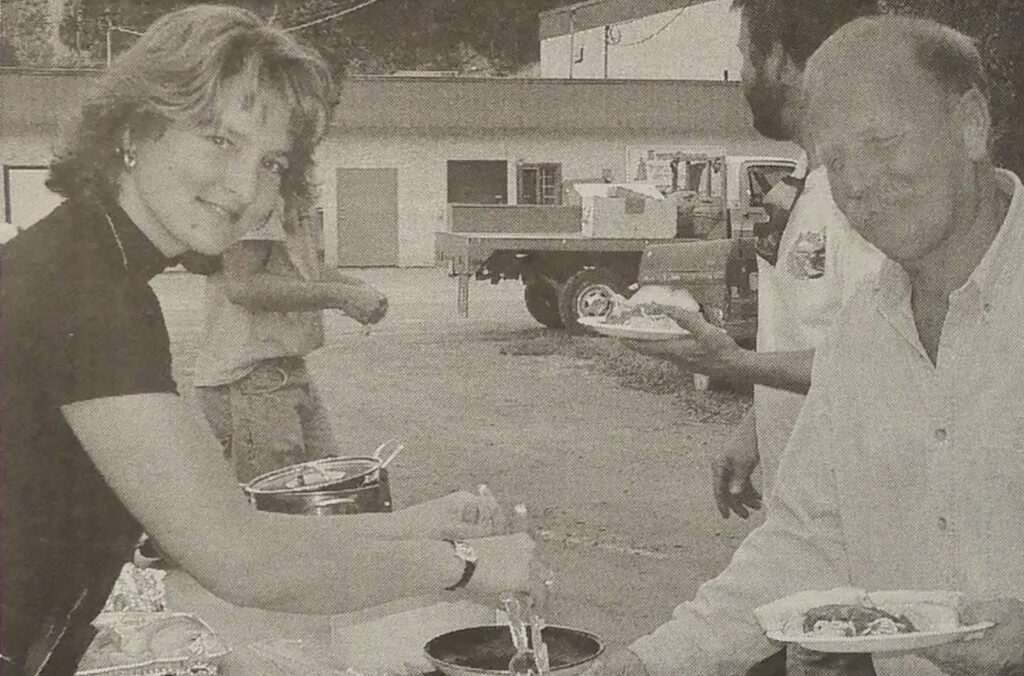
When more than 100 Timber Framers Guild members descended on Golden in September 2001, they found a town ready to meet them with open arms — and open doors. Housing and caring for a travelling workforce of that size was itself a formidable undertaking, and Golden rose to it with characteristic warmth.
The Rotary Club of Golden played a central organizing role, working for months to arrange billeting across the community — in the campground, in local motels, and in the spare rooms of Golden families who volunteered their homes. A memorable newspaper advertisement captured the spirit: “TIMBER FRAMERS FREE TO GOOD HOMES — No feeding required, just provide a bed and a shower for the full two weeks or a few nights.” Families and singles, men and women, smokers and non-smokers — all were matched with a place to land.
The Rotary Club also found a way to make the bridge a community investment in a more literal sense. Bob Finnie, who headed the club’s planning committee, organized a campaign to sell the wooden pegs that would lock every timber joint together — one peg per community member, if Finnie had his way. “They won’t be able to see their names,” said Finnie, “but at least they’ll know they’re there.” The names of Golden residents, invisible and permanent, are pressed into the heart of the bridge to this day.
Guild executive director Joel McCarty knew exactly what this generosity meant. “This time,” he said, “is about hospitality, friendship and romance. It reminds us what collective action can accomplish.”
He was right. The bridge was completed for a fraction of its commercial cost, in large part because Golden gave so freely of itself.
From Forest to Frame: The Timber Suppliers and the People Who Fell the Trees
Before a single joint was cut, the story of the Kicking Horse Pedestrian Bridge came perilously close to a very different ending.
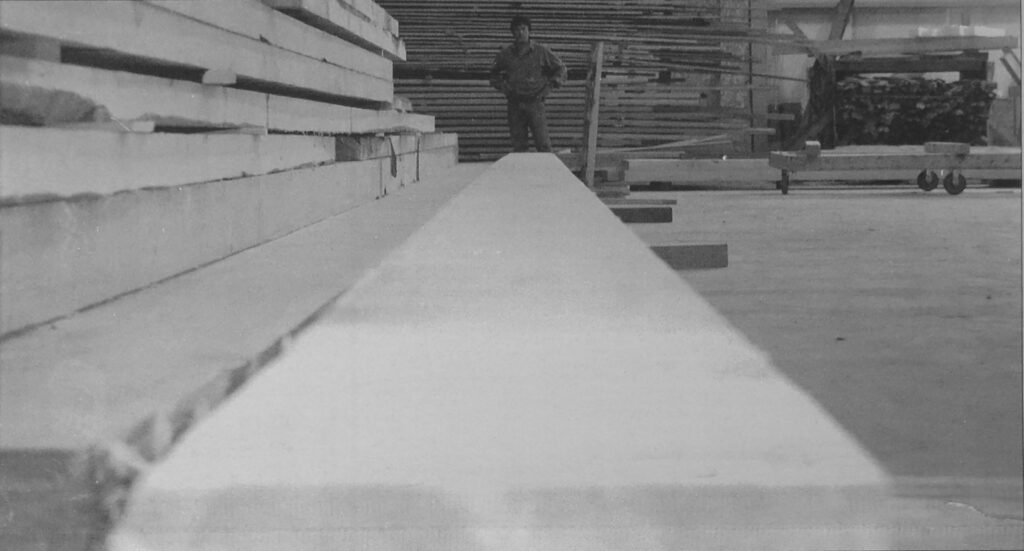
The bridge’s design called for 54-foot beams — long, straight Douglas-fir timbers that are both rare and expensive. With the build date approaching and no supplier confirmed, Economic Development Officer Lee Malleau and the project team had already begun drafting Plan B: shortening the design to accommodate smaller pieces joined by metal clamps. It would have been equally strong, Malleau acknowledged, and perhaps undetectable to most eyes — but timber framing purists would have known the difference.
Then Tembec Industries stepped in, donating $5,000 worth of premium-grade fir trees of the required length. “They literally saved us,” said Malleau. Louisiana Pacific Engineered Wood Products added a further donation of 300 cubic metres of wood, ensuring the project had everything it needed to proceed with the original vision intact.
Getting the long logs was only half the battle. Cutting them was another challenge entirely. Jim Oseychuk, contracted by Canadian Timber Frames to prepare the timber, found that almost no mill in British Columbia could handle logs of that length. The solution was bold: fit the existing saw with two 24-foot extensions, sourced from Woodmizer Canada in Salmon Arm. The assembly and calibration took four days — and produced a machine capable of cutting to one-sixteenth of an inch in accuracy over a full 54 feet. It was the first time such a configuration had ever been used in Canada.
From donated trees to precision-cut beams, the material story of the Kicking Horse Bridge is one of ingenuity, generosity, and last-minute grace under pressure.
A Dream Takes Shape: The Vision and Planning Behind the Bridge
Every great community project has a spark. For the Kicking Horse Pedestrian Bridge, that spark was struck in April 1997 — not in Golden, but in West Virginia.
Cristoph Loesch, a Golden resident and member of the Timber Framers Guild, was in Lexington at the time, helping fellow Guild members build a medieval trebuchet catapult for the Virginia Military Institute. He was also preparing to move home to Golden from Maryland, and as the work progressed, he began talking to his Guild colleagues about the possibility of a project in his adopted hometown. The Guild had many members in British Columbia and was keen to give something back to the province. They were immediately interested.
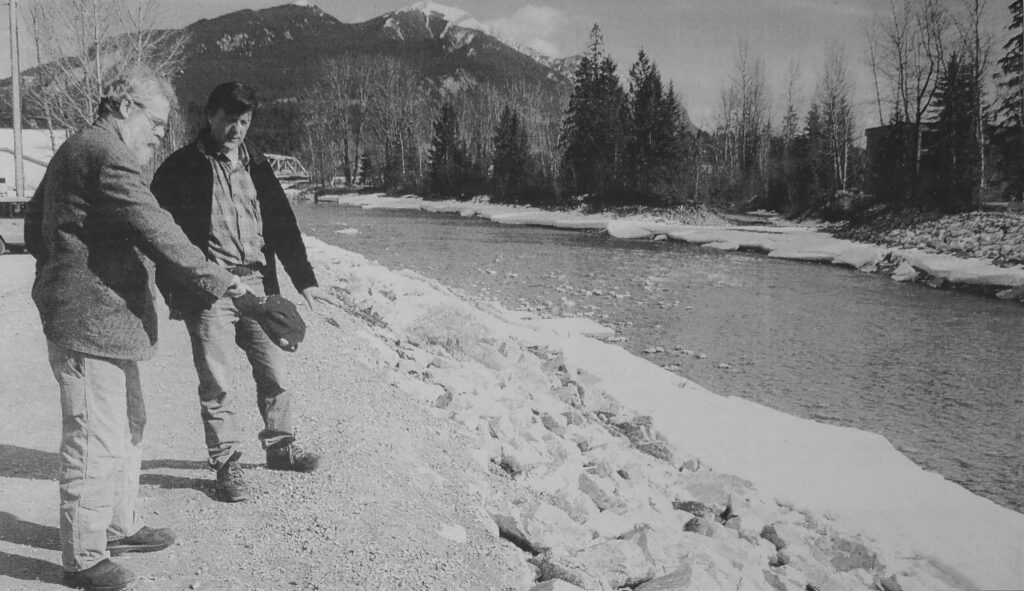
Loesch brought the idea to Golden’s Economic Development Officer, Lee Malleau. What followed were four years of fundraising, engineering, material sourcing, community organizing, and careful negotiation. “Four years later, after many headaches and heartaches, here we are,” Loesch would later reflect.
The Guild’s own mandate shaped every step of the process. They would only commit to a project with a genuine community purpose — one that was simply impossible to complete without their donated labour. A 150-foot clear-span timber frame pedestrian bridge over the Kicking Horse River, connecting Golden’s downtown to its neighbourhoods, met every criterion.
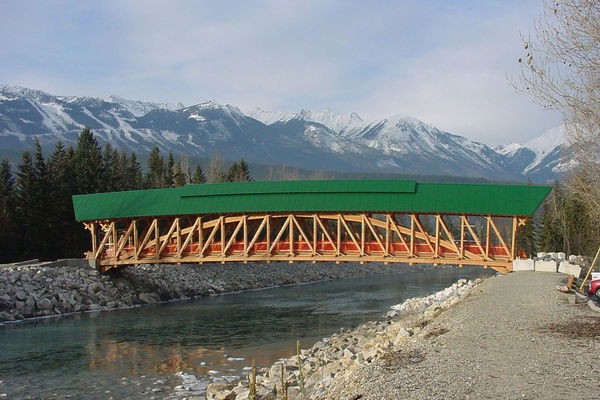
Cascade Engineering Group came on board as the Structural Engineer of Record, giving the design a Swiss chalet character that echoes Golden’s historic connection to the legendary Swiss mountain guides. The Rotary Club organized billets. Tembec Industries donated the timber. The community rallied around every need.
When the first truss rose on the evening of September 4, 2001, Loesch stood at the riverbank and watched. “It was hard to believe it was true,” he said. “It was a very moving moment for me.”
The Art and Engineering of Timber Framing: A Craft Five Centuries in the Making
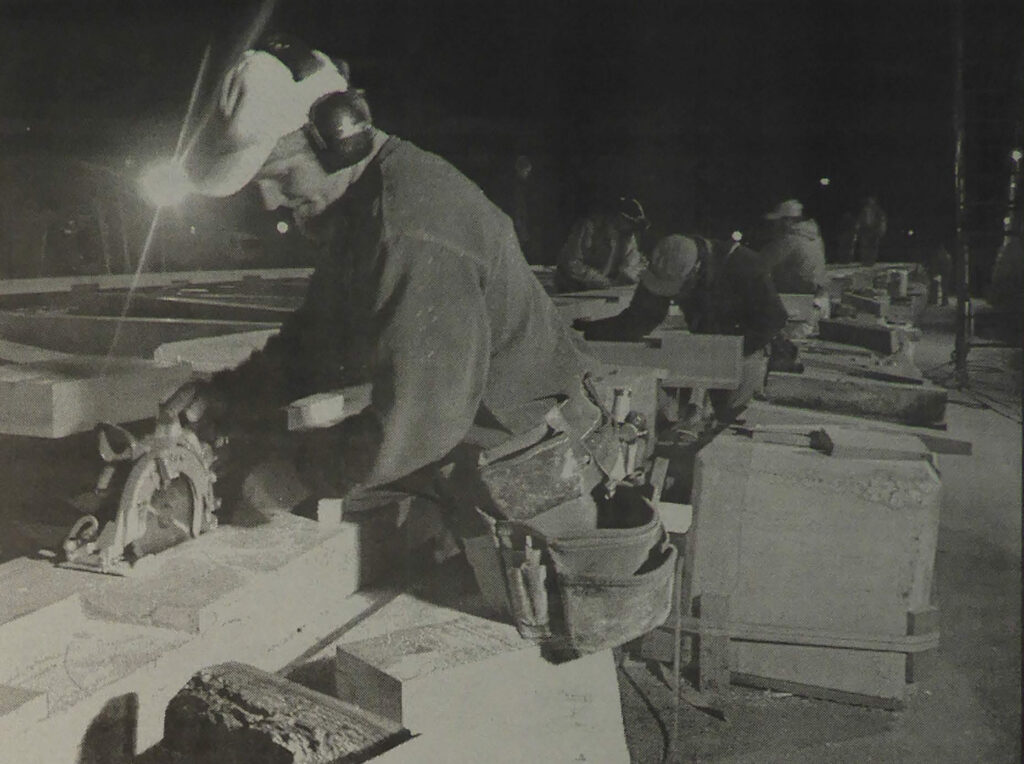
To watch a timber frame being raised is to witness one of humanity’s oldest building traditions brought back to life. And according to Joel McCarty, executive director of the Timber Framers Guild of North America, that tradition nearly disappeared for good.
“These building techniques were all but wiped out by the invention of the wire nail and the power sawmill,” he explained. “The knowledge is no longer passed on from father to son like it had been for thousands of years. Now you have to study old bridges and books. So our work is a way to bring the knowledge back, and to pass it on.”
The Kicking Horse Pedestrian Bridge is one of the finest expressions of that recovered knowledge in Canada. At 150 feet, it is the longest freestanding timber frame clear span in the country — the craft at its most ambitious scale.
What sets timber framing apart from modern construction is its joinery. Rather than metal fasteners, timber frames are held together by mortise-and-tenon connections: hand-cut pockets and precisely matching tongues, locked with hardwood pegs. The wood itself carries the load, distributing stress through the frame in a way that strengthens over time. In Golden, those pegs carry special meaning — the Rotary Club sold them to community members before the build, meaning the invisible names of Golden residents are locked permanently into every joint.
Achieving that connection at the scale of a 54-foot beam — cut to one-sixteenth of an inch accuracy on a specially extended saw that had never before been built in Canada — speaks to the remarkable partnership of ancient craft knowledge and modern ingenuity that made this bridge possible.
The Guild’s tradition holds that anyone who wanders onto a build site is welcomed and put to work. In Golden in September 2001, they meant every word of it.
Twenty-Five Years Standing: The Bridge as a Symbol of Who We Are
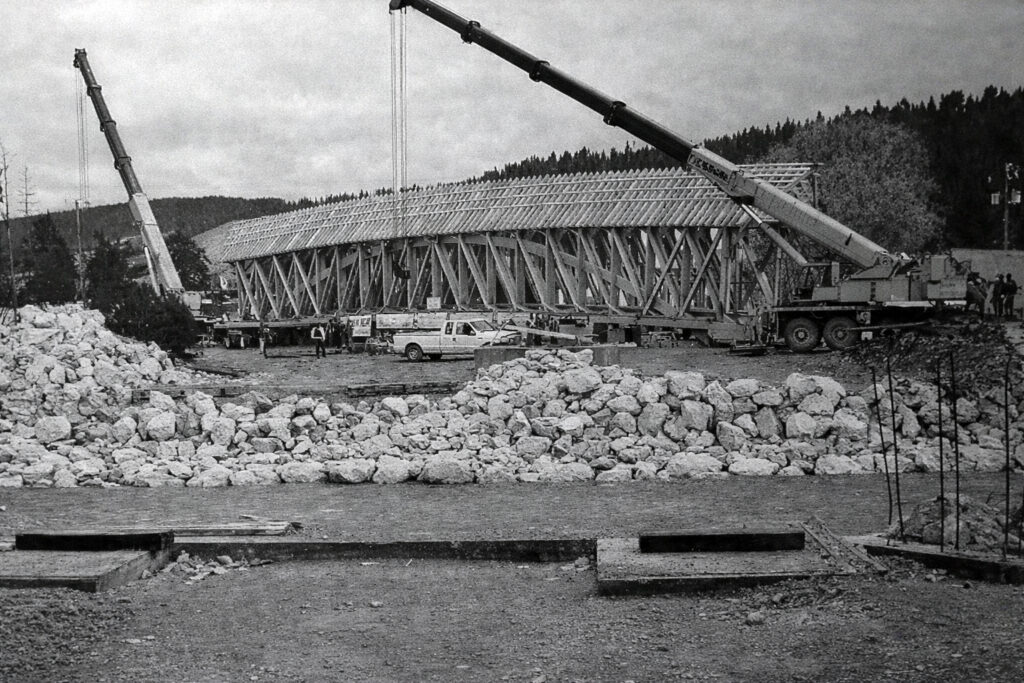
On the evening of September 4, 2001, the first timber truss of the Kicking Horse Pedestrian Bridge was lifted into place over the river. Cristoph Loesch — the Golden resident whose conversation in a West Virginia workshop four years earlier had set everything in motion — stood and watched. “It was hard to believe it was true,” he said. “It was a very moving moment for me.”
Twenty-five years later, that moment lives in the structure itself. It lives in the 54-foot Douglas-fir beams that Tembec Industries donated at the eleventh hour, rescuing the design from compromise. It lives in the precision cuts Jim Oseychuk and Canadian Timber Frames made on a saw extended to a length never before attempted in Canada. It lives in the wooden pegs — bearing the invisible names of Golden residents who bought them through the Rotary Club — pressing silently into every joint. And it lives in the spare rooms and campground sites where Golden families housed a hundred timber framers for two September weeks, no feeding required — just a bed, a shower, and a welcome this town knows how to give.
Joel McCarty, the Guild’s executive director, put it simply: “This time is about hospitality, friendship and romance. It reminds us what collective action can accomplish.”
The bridge earned the Communities in Bloom Most Innovative Project award in 2001. When deterioration was found at the abutments in 2016, the community rallied again, completing careful repairs in 2017. The bridge was built to last — and Golden has made sure that it does.
But its truest measure is daily and unhurried: the footsteps of commuters and schoolchildren, of visitors pausing to photograph the river, of neighbours crossing the Kicking Horse to reach each other. Twenty-five years on, it is still holding.