
Ted Jacobson
From the Golden Star, April 4, 1979
For a number of years in the latter half of the 1970’s the Golden Star ran a series called Nostalgia. It ran on a semi regular basis and featured locals who were interviewed for their stories and their memoires of Golden.
This week, we begin a nostalgia for Ted Jacobson. Ted is a youngster still at 62, but has a tremendous wealth of first-hand memories and stories handed down by his parents and friends that, together with his unrivalled collection of photographs, paint a clear picture of much of Golden’s past. Ted presently works for the school district as bus superintendent. He and his wife Doris, live at 626 7th St N. With him lives his grandson, Mark Murray.
At the time of the First World War, Golden looked a little different from how it does now. The part of Highway 95 now called 10th Ave South, from the Kicking Horse River, was the area of town in which Ted Jacobson was born in 1917. At that time, the west side of the road was dominated by the Imperial Bank, standing where Mount Seven Taxi presently has its headquarters and by HG Parson’s store, situated in the area of the present IGA parking lot. Between them was the original Golden Star office and printing chop, still standing today, and until recently, housing the Golden Garden shop.
Across the street, the dominant building was the Russell Hotel, standing where the Golden Civic Centre is today, a large, white painted 2 story building, the only hotel south of the river, and a popular overnight stop for lumberjacks and up-valley people on their visits to Golden to shop. Owned by HG Parson, Ed Jacobson and Bill Pearlstrom, and operated by Ed, this was Ted Jacobson’s early home.
The hotel was flanked on the north side by two buildings. Next door was Arthur Hamilton’s livery stables, later to become a garage and, in 1932, to be burnt down by thieves. It was this fire that caused the destruction of the Russell Hotel.
North of the livery stables was the blacksmith’s shop situated close to the Bank of the Kicking Horse, next to the bridge which, at this time, had been moved upstream, so bringing it into line with the highway. Later, the bridge was moved back to its original location, crossing Gold’s Island, where the Golden Gazette is situated today. Ted has photographs of Canadian soldiers marching up 10th Avenue and straight across the wooden bridge in the days when its location was upstream. The various changes of location of the bridge reflected changes in the government of the day. Ted was no more than a babe in arms at this time, held up on the balcony of the Russell Hotel by his mother, perhaps, to see the soldiers pass.
South of the hotel, across a patch of open ground, stood a Methodist church, where Robinson’s store is today. Later, this church was sold and moved upon the union of the Methodist and the Presbyterian Church into the United Church of Canada.
It was, in fact, very much a commercial section of town, as it is today. Young Ted found new playmates living close by, as the residential section of Golden was all further south, clustered around the Columbia River logging mill yard, where most Golden residents worked, in what is today 12th, 13th, and 14th streets.
He was lucky to find two other youngsters equally isolated. Tannis Reid, daughter of the bank manager, lived in the suite above the Imperial Bank across the road. Jackie Gibson, the minister’s son, lived in the manse close by. These three became inseparable companions for the first four or five years of Ted’s life. They were joined and faithfully accompanied by Patty, Arthur Hamilton’s dog from the liberty stable next door. Although he never owned the dog, Ted looked upon Paddy as his. They get into all sorts of mischief in and around delivery stables and the blacksmith shop, their favourite playgrounds.
This was only the beginning of a long association with Arthur Hamilton, whom the young Ted looked up to almost like a father. Arthur Hamilton was one of the first people in Golden to own a car, a Model T Ford. He took Ted for his first ride, held him in his mother’s arms, preceded into the car by Paddy. Ted had not infrequent jaunts in the Hamiltons’ car.
At the end of Arthur Hamilton’s life, Ted was to take him for his last drive in the country. By this time, Ted had driven professionally for Arthur for many years.
But that is jumping the gun. In those early days, there were not a dozen cars in Golden. Ted’s dad bought a car, but never learned to drive. He employed Jim Crook to drive for him. Ed Jacobson’s car was a 1911 Model T Ford.
The roads were gravel or dirt, and out of town, were narrow and winding. A favourite car ride was to Tony Pellegrino’s farm, then nine miles south, just beyond where Arkinstall’s (Cammamo) mill now stands. Radium Hot Springs was a all day trip. The family would start out early in the morning and stop for a picnic lunch on the way. The bathhouse at the Hot Springs in those days was a large, open building, partitioned down the middle to separate the men and women. Long bathing suits were all the rage. The journey home, passing through Sinclair Canyon, negotiating the narrow bridge over the creek, would not be over until nightfall.
Ted’s childhood friends left town as their fathers were transferred to other parts of the country. He then piled up with Bill and Pat Shepard, who lived by the railroad tracks, where Golden Toyota operates today.
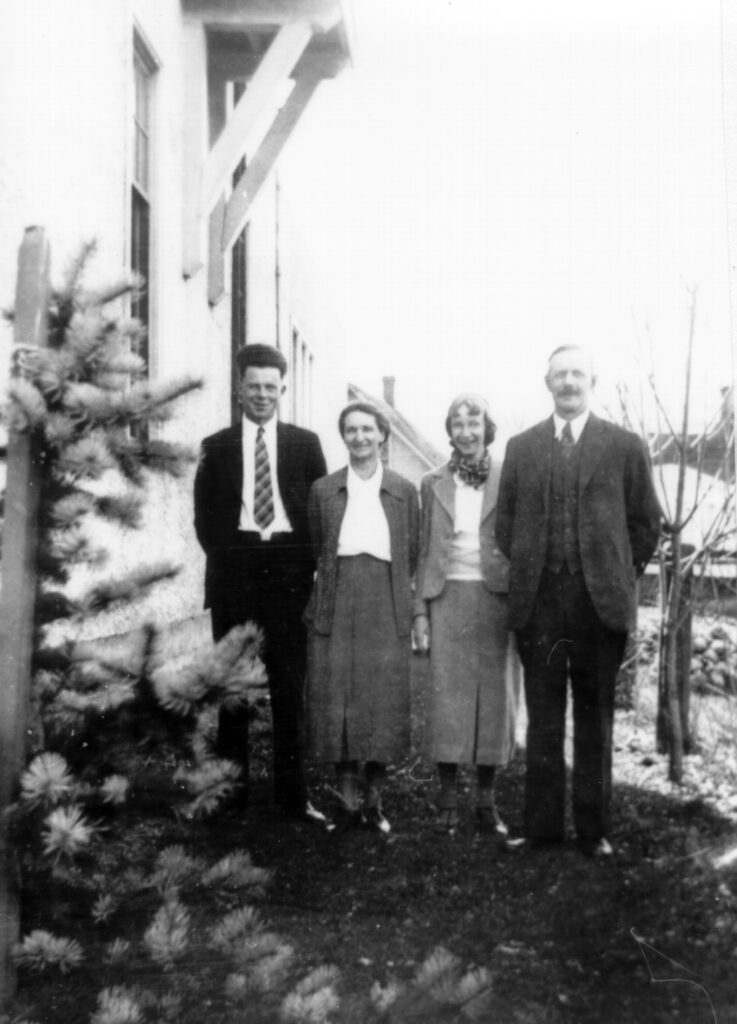
When Ted was six years old, his sister, Baeda, was born. About this time the family moved from the Russell Hotel and lived in a house on 11th Street. The Columbia River logging company had closed down its operations. Extensive forest fires had caused a serious shortage of timber. This had ramifications for all the town’s businesses. The Russell Hotel’s trade dropped off markedly. Ted’s dad kept his interest in the hotel with HG Parson, but moved out of it and started logging on his farm at Donald. He cut poles and was successful enough to begin building the Fridheim Hotel, on the north side of the river, in Golden’s downtown section, where he hoped to pick up better trade with the opening of the road through the Kicking Horse Canyon from Field. The Fridheim opened for business in the late 20s. After enjoying life in the residential part of town with many playmates close by, Ted once more found himself relatively isolated in the commercial part of town. At that time, the Queen’s Hotel, Golden Lodge, and Columbia House were all vying for customers.
Kootenay House was still operating as a post office at this time. The Fridheim stands across the road from the CPR tracks. In those days, a steam locomotive shop stood directly across from the hotel. Young Ted, always fascinated by machinery, ever since his early days around Hamilton’s livery stables and Arthur Hamilton’s car, spent hours across the road. The locomotive charge hand and the pump man taught Ted all he could learn about the operation of a steam locomotive. Every day after school, which he disliked and did not do well at, Ted rushed through his chores and went over to the locomotive shop. His hopes at that time were that he could become a locomotive steam engineer. It took his mind off his schoolwork. He dreamed about engines instead of concentrating on his lessons and grew to hate school. By the time the depression hit, Ted was in grade 7. Although his parents didn’t want him to, he decided to leave school and go to work. He was 14 when he started looking for a job. At 14 years old, he didn’t have much chance of getting on with the CPR.
He tried to get work on the construction crew on the Big Bend Highway where his friend JoeYurik’s elder brother, Bill, was working, but couldn’t get work. He took any jobs he could get, helping people around town. In the right season, he and Joe Yurik would catch a ride on the blind or tender of a passenger train to the Connaught Tunnel to go huckleberry picking. The engineers knew they were there but never seemed to mind. Before entering the tunnel, the train stopped and the engineer signed in a logbook at the shed beside the track. The same procedure was followed to exit from the tunnel on the return journey. Although Ted never knew why they did this, he did know that it guaranteed them a ride home. In a good huckleberry season, they’d sell their surplus that their families couldn’t eat to Casey at his café.
Ted took many jobs in those early 30s. When the Columbia Power Company took over the CRL, the generation of power for Golden and erected a new power plant, Ted helped lineman Harold fFoulds as new electricity carrying lines were erected.
For a while, he was Golden’s lamplighter, riding his bike around the dozen or so street lights at dawn and dusk, turning the lights off and on, for the princely sum of $5 a month.
He took tickets at the door of the Lyric Theatre before it burned down in April 1931. Those were the days of the silent movies. Jack Gareb owned the Lyric and was the projectionist. Yvonne Mercier used to play the piano. Alice Shepard sold the tickets, and Ted was the doorman. It kept him busy as every time they changed film reels, there was an intermission and members of the audience trooped next door to Loy’s Café for candies et cetera.
We never were hungry, remembers Ted. We were always warmly dressed, but we never had no fringe benefits, no candies, nothing. So it was a real opportunity to get to see the movies free.
Among other jobs, Ted changed tires at Hamilton’s garage and livery, for pennies. He cut Christmas trees. He helped local plumber Jim Lenny.
It was during this period that Hamilton’s livery stables and the Russell Hotel burned down. Hamilton rebuilt his business across the river. He built a garage where Thompson and Neville now stands.
In 1933, Ted got his driving license and a commercial license to boot. It cost $38 a year to get a license to drive auto delivery or commercial. Ted’s dad paid for his license and Ted finally got a job with Arthur Hamilton, driving for his cartage operation. He worked pretty steadily, driving and working as a mechanic at the garage. He worked alongside of Ken Woods, Vaughan Kimpton, with whom he was later to go into partnership, Cliff Reynolds and Ernie Anderson. Sid Neale was the accountant. Later on Court Neville joined the workforce.
In the middle of the winter of 1935, one of the more dramatic incidents in Golden’s history took place. Ted was unloading coal at the Legion Hall on the southern edge of town for Hamilton’s cartage. He heard a tremendous explosion and immediately identified it as a steamboiler exploding. He drove his truck as fast as possible to the locomotive shop track adjacent to the CPR Station. There, he found people already assembling around clouds of steam and smoke and widely flung debris. On the tracks was left a set of locomotive wheels. Alongside was a standing engine with its firebox still raging. In the snow for hundreds of feet around lay bits of twisted metal, the remains of the boiler and cab of the locomotive. An oil shed that had stood alongside the stationary locomotive was completely flattened. The other locomotive engine stood alongside. Ted climbed into its cab and discovered that the firing valve was in the full open position it had probably been blown open by the concussion of the explosion immediately adjacent to it. Realizing the danger, Ted closed the valve and left the cab as fast as possible. Rod Drown, Ray Drown’s father, coming on duty, opened the steam cocks. This action probably prevented a further explosion, which, with the crowd gathering around, could have caused serious loss of life. As it was, due to the 20 below Fahrenheit temperatures, workmen and passengers were inside the station waiting room, from where they had a front row seat without coming to any harm.
This was not the only occasion on which Ted Jacobson hit the headlines in the Golden Star. One of his jobs was delivering ice to those people who owned ice boxes. He had a habit of looking in their ice boxes to see what tasty morsels might be lying about. On one occasion, he had spied two cream pies on a windowsill where the family’s cook had left them to cool. Ted thought that there was one too many, and so he took one. However, the thief was not undetected and Pop Fisher, editor of the Star, gave him a write-up. Ted’s main duties for Hamilton’s cartridge company were loading and unloading coal, flour and feed for the stores, and hauling beer and liquor for the liquor store and hotels. Hamilton’s cartridge hauled a great percentage of commodities coming in by rail. Ted also drove auto livery cars. On several occasions, he was assigned to drive Senator King from Golden Cranbrook, his old constituency. The senator would arrive in Golden from Ottawa on the train and return via the same route. Shortly after the senators returned to Ottawa, Ted would receive a check for twenty-five dollars, his tip for services rendered, a very welcome sum during the Depression.
Ted made weekly trips up the Big Bend Highway for several years, chauffeuring Dr Ewart to the survey and construction camps for which he was the medical officer of Health. Dr Ewart had a bad heart condition and so was not supposed to drive himself.
Arthur Hamilton died in 1937, leaving his wife, Beatrice, to settle up his affairs and dispose of the garages. By this time Mr Hamilton had bought the Golden Motors garage from Jack Gareb and had set up Vaughan Kimpton to run it. After her husband’s death Beatrice Hamilton made it possible by most generous terms on the deal, for Ted Jacobson and Vaughan Kimpton to buy Golden Motors while Tom King bought the Hamilton garage. This he later sold to Sam Thompson.
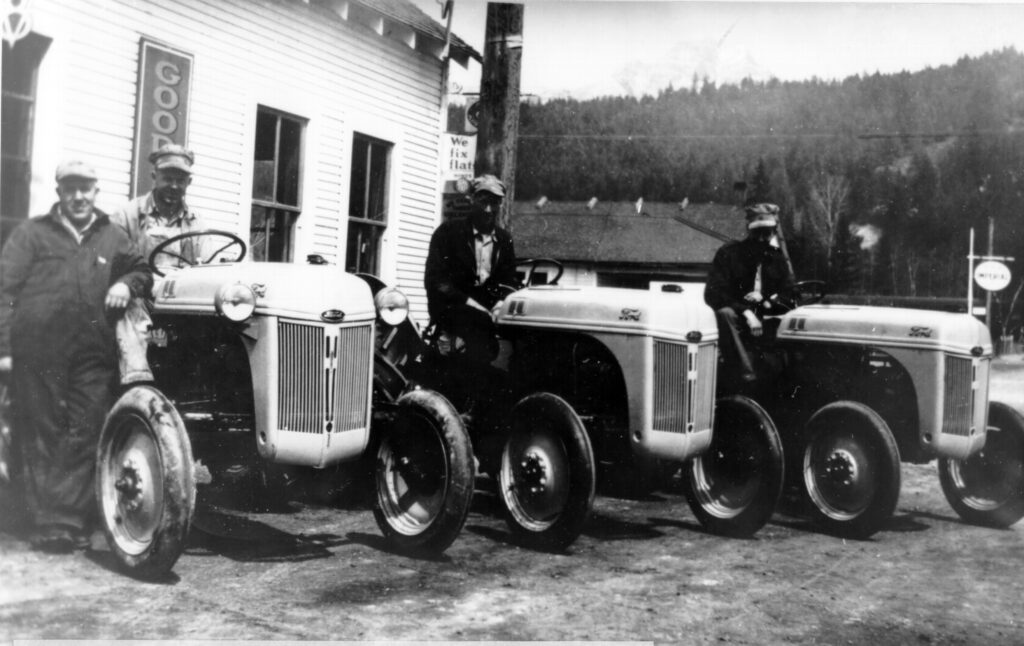
Ted and Vaughan Kimpton started business together on the 15th March 1938. With the exception of the war years, during which time Vaughn ran the business, Ted worked from then to May first 1962, as partner and operator of Golden Motors. The effects of the depression were still being felt in 1938 and to make a go of it, Vaughan and Ted had to sell radio sets and refrigerators in addition to the 7 or 8 cars they could sell in a year. They held the Ford dealership and sold first shell and then British American gasoline. They ran a cartridge business, delivering coal to homes and businesses. In those days most homes still had stoves and space heaters and coal had not yet replaced by coal by oil.
They also continued their auto delivery service, by then being referred to as a taxi service. In addition Ted operated the first wrecker in this area. He worked from Revelstoke six hours away via the dusty, bumpy, Big Bend Highway, to Field, via the narrow and winding Kicking Horse Canyon. Little work was forthcoming to the South. Ted recalls that until the Trans Canada Highway was built and the road widened, an accident in the Kicking Horse Pass was almost unheard of. Some of their calls were to stranded Greyhound buses on the Big Bend to Revelstoke. Ted spent many hours following the dust of the big Greyhounds round the ruts and rocks of the Bend.
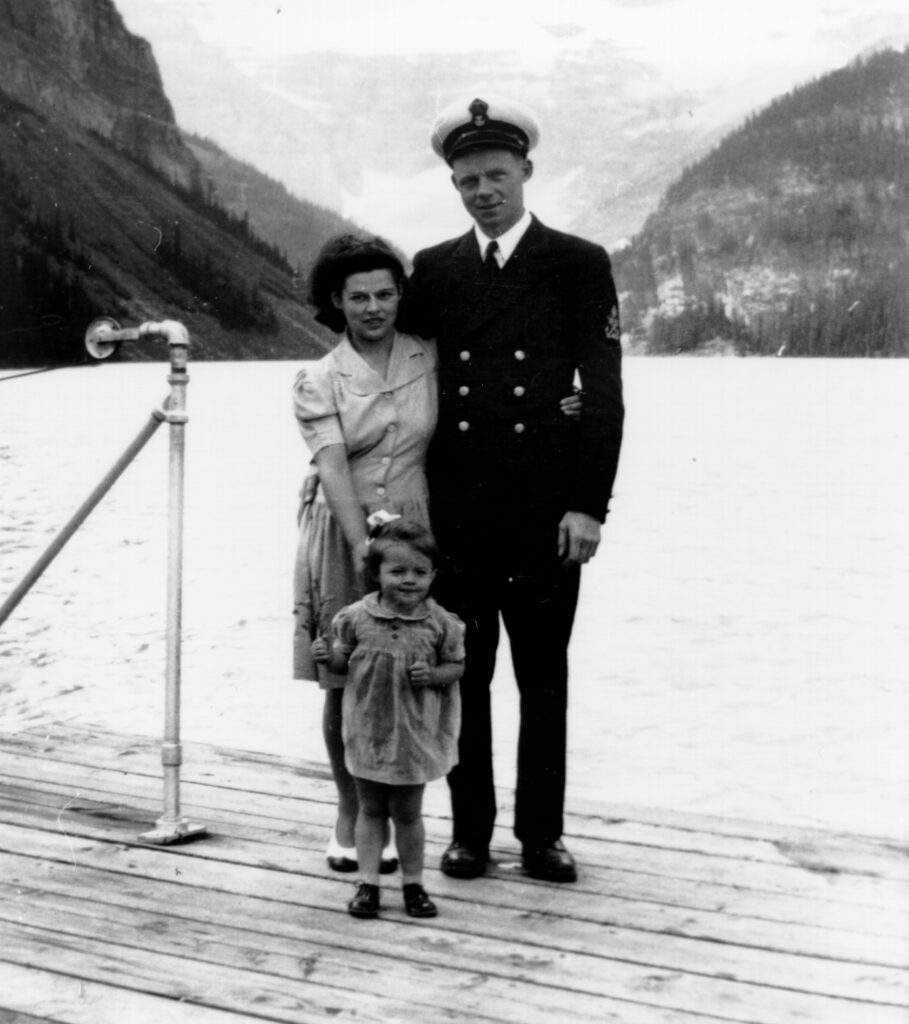
When the outbreak of World War II heralded the end of the Depression Ted married Doris Feuz, a girl he had known since early school days. They lived across the tracks from the station where they lived and raised their three children until moving to their present home on 7th Street North in 1952.
Ted joined up in 1942, first joining the Canadian Army and then transferring to the navy, where his skills as a mechanic put him in the engine room of a Fairmite sub-chaser, operating out of the Esquimault naval base. “We never saw anything,” reports Ted.
Later he worked on an examination vessel out of the port of Vancouver, where he rose to the rank of Petty Officer.
During the war, Ted and Doris had two daughters born to them; Margaret (now Murray, living in Edmonton) and Baeda (now married to Hub Henderson and living in Golden). After the war their son Walter, (now living in Three Hills, Alberta) was born.
The children all attended school in Golden at one school, then standing where Golden Elementary is today. Each of them, now married, has provided Ted and Doris with three grandchildren, one of which, Mark Murray, is presently living with them.
Ted was offered a permanent job in the Navy following the war but turned it down. Although he had travelled quite widely he had found no place like this valley, and so he returned here, to his garage business.
One of Ted’s memories of that time is of the famous silk trains that used to come through Golden. C.P.R., competing for rich, silk orders from the Orient with C.N.R. and American railroads, ran their fastest steamers on the run from Vancouver to Eastern U.S. and Canadian markets. “The engines were clean and shining,” recalls Ted.
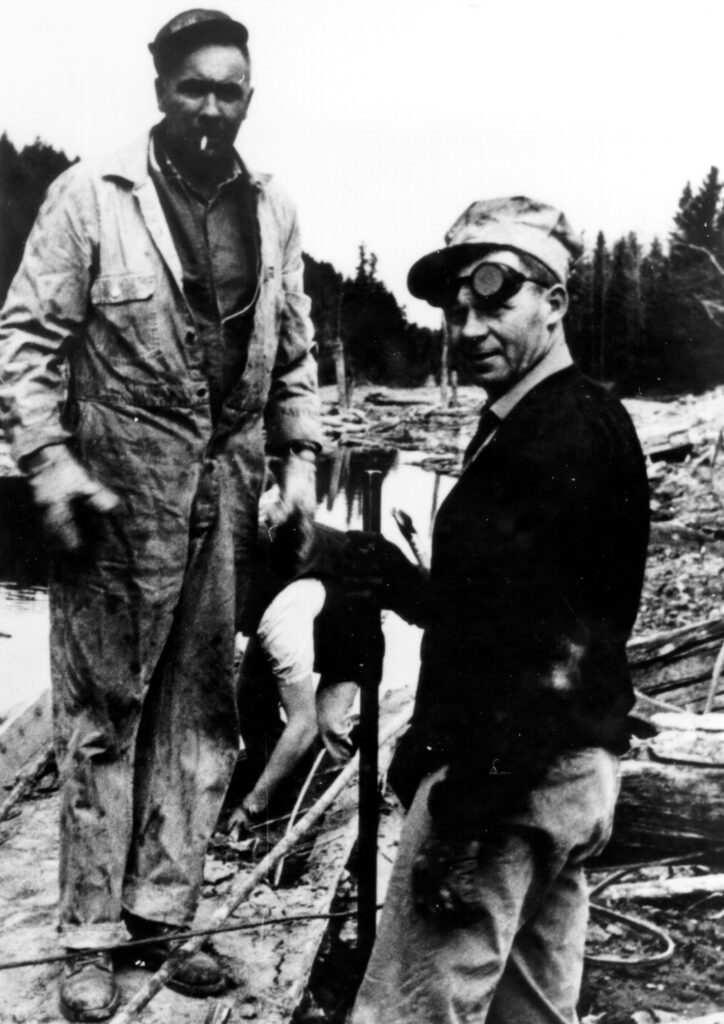
On May 1st, 1962, Ted sold his share in Golden Motors to his partner, Vaughan Kimpton, and accepted a request from the School Board to work for them, running their school buses. By this time, population increases had caused the construction of schools in the rural areas, and Ted has been driving school buses since the 40’s. He is still the bus supervisor for the School District.